History of Camp Rokiwan
 Written by Dr. Larry K. Hoffman, D.D.S
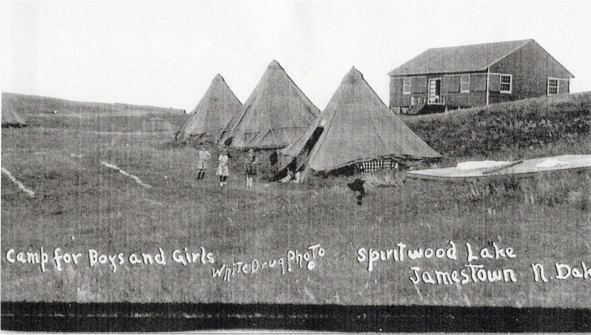
In 1923, the Rotary and Kiwanis Clubs each donated $6.00 per member (73 Kiwanians and 43 Rotarians), along with $300 from each club and $60 collected in fines, to establish a camp at Spiritwood Lake.
Additional fundraising included an aerial show ($100), the Home Guard ($80.89), and contributions from local businessmen ($41.75).
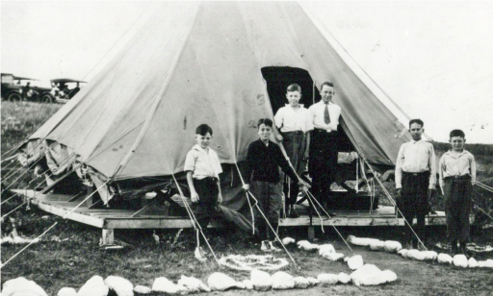
The clubs paid a total of $3,160.41. This amount included the purchase of 8 acres from Wallace-Donnley Co. for $500, construction of a lodge, and two large tents with wood floors. The men of the clubs constructed the lodge themselves. It was reported that “only one member fell off the roof, and he was not hurt very much.” The ladies furnished lunches. Oscar J. Seiler, chairman of the Joint Committee, stated that “the camp, overlooking Spiritwood Lake, is conceded by everybody to be one of the finest summer resorts in the whole wide state.” Harry C. Flint, a Rotarian, allowed the service clubs the use of an additional 5.03 adjacent acres, bringing the total land area to 13.03 acres.
The first camp hosted 15 campers, followed by a second camp with 35 campers. In the early years, the camp was used by a girls’ camp, the Hannaford Boy Scouts, and the Jamestown College football team. A commissary selling candy and pop provided a source of income of approximately $30 per month.
In 1926, three boys’ camps and one girls’ camp were held, each lasting more than 10 days. Total camper days for the year numbered 1,187, with total expenses of $1,268.23, equating to $1.08 per camper per day. Cooks for the girls’ camp were Eunice Sisson and Mrs. Peterson, while Lloyd Thomas and Ted Cross served as cooks for the boys’ camps. Total salaries for the summer amounted to $110.50.
On June 6, 1933, the Rotary and Kiwanis Clubs of Jamestown formally incorporated Camp Rokiwan, Inc. and acquired the deed to the original 8 acres, which had been held by the Jamestown YMCA since 1923. As Camp Rokiwan had not previously been incorporated, the YMCA had retained the deed from Wallace-Donnley. A nine-member Board of Trustees was established to govern the corporation. Originally, the board consisted of four members from each club and one member at large (Mae Flint). This was later reworded to four members from each club and one member at large.
The stated purpose of the corporation was to promote the ability of boys and girls to do things for themselves and for others, and to teach patriotism, courage, self-reliance, and kindred virtues.
For several years, the camp continued to be overseen by the YMCA. As YMCA involvement waned, the local Boy Scouts grew and soon assumed management of the camp. The Boy Scout Council, along with the Rotary and Kiwanis Clubs, continued to provide financial support. By 1940, Camp Rokiwan was being used by Farmers Union Juniors, Foster County 4-H leaders, Boy Scouts, Girl Scouts, and Stutsman County 4-H.
In 1945 and additional 6 acres was deeded to Camp Rokiwan by Mrs. Flint, bringing the total acreage to 20 acres. Through the efforts of Dr. Lloyd Musburger, two dozen single iron beds were obtained from the state hospital. The beds were overhauled, painted, and put to use at the camp.
In 1948 Camp Rokiwan had beds for 55 campers and dished for 100 campers. The Trustees increased the camp use charge per camper from $0.50 to $1.00 per week.
In 1949, Mrs. Flint establishes the "Harry C. Flint Memorial Fund" in the amount of $10,000 with the stipulation that the interest be used for Camp Rokiwan. As part of the donation, the camp was to be renamed the "Harry C. Flint Boys Camp." This was later changed to "Harry C. Flint Camp for Boys and Girls." A bronze plaque bearing that name has been placed on a rock on the camp grounds.
By 1950, the camp is sold out for June, July, and the first week of August. The first caretaker, Neil Cummings, was hired in 1956. He commuted nearly every day, maintained the camp, and checked on campers for $100 per month. That same year, Camp Rokiwan had a total of 340 campers with 180 staff members.
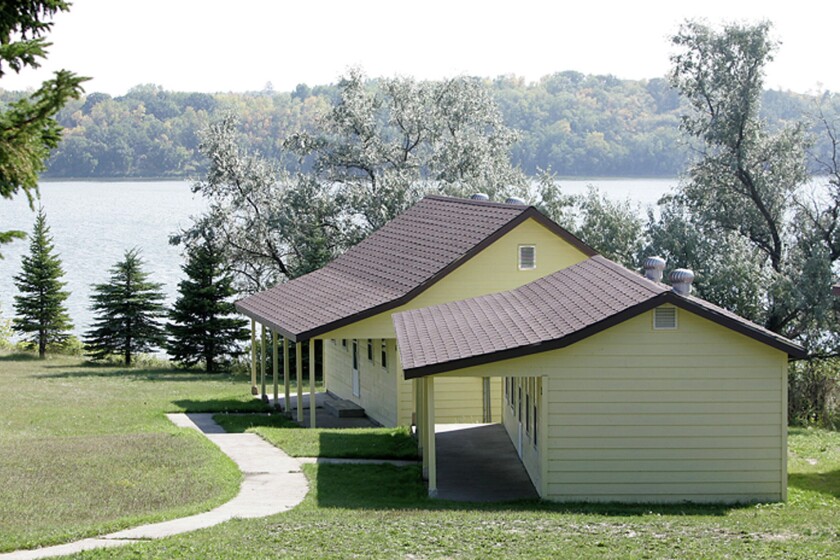
During the 1960s, several cabins were insulated, and a potbellied stove donated by Clarence Cummings was installed to accommodate Boy Scout winter camping. A caretaker’s cabin was constructed and occupied by Orville LeMay. A new bathhouse with showers and restrooms replaced the outhouses, the dispensary was torn down, and a garage and utility shed were built. Members of the Rotary and Kiwanis Clubs turned out annually for spring cleanup. A street sign was erected to honor long-time trustee Marv Tokach. The Don Nierling Estate was a major contributor of funds for renovations and ongoing maintenance.
During the 1960s and 1970s, Stutsman County Welfare provided lists of families, and camp representatives visited homes to speak with mothers about the benefits of camp. Most families welcomed the opportunity for a free camp experience. By the 1980s, social services no longer released family names, and many children who could have benefited were missed. In one year, another service club provided Camp Rokiwan with the names of Christmas basket recipients. Scholarships were awarded generously.
From the 1960s through the 1980s, Henry Lahaug, a Rotarian, served as superintendent of the State Hospital, which operated a dairy barn, bakery, and vegetable gardens. Fresh-baked bread, a variety of produce, and a can or two of whole milk were delivered to the camp each morning. On the first day of the twice-daily cookie and milk line, the children eyed the milk—cream floating on top—with suspicion. By the second day, it was “like a herd of calves heading for the cookie line.”
One of the most recent acquisitions for Camp Rokiwan was a small house donated by the Anne Carlsen School in 2010. The house was moved to Spiritwood Lake, a basement was constructed, and a deck was built. It now serves as the residence for the caretakers.
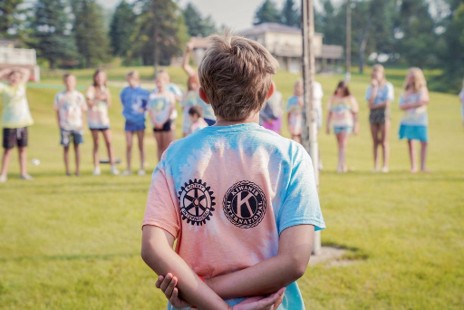
The purpose of Camp Rokiwan has always been to benefit children in Jamestown and the surrounding area. Camps were held consistently until 2020, when the pandemic made operation difficult. Camp Rokiwan remained a priority for both the Kiwanis and rotary Clubs. In 2023, a joint committee was formed and tasked with bringing back children's camp. Camp officially resumed in August 2024 with approximately 45 campers and continues today. Members of both clubs enjoy spending time at the camp, cooking meals for the children and participating in activities.